

The airbag module is a critical component of a vehicle's passive safety system, designed to provide additional cushioning and protection to the driver or passengers in the event of a collision that meets specific deployment criteria. These modules are typically installed in locations such as the steering wheel, dashboard, the sides of seats, or along the roofline, with the specific configuration depending on the type of airbag and the vehicle's design.
For automotive parts procurement professionals and vehicle manufacturers, understanding the composition of an airbag module is essential for evaluating product specifications, vehicle compatibility, and a supplier's quality control capabilities. Suppliers of airbag modules must provide tailored solutions based on a client's specific vehicle platform, installation location, and technical requirements.
1. Airbag Cushion
The airbag cushion is a core component of the module, typically manufactured from specialized, high-strength, and heat-resistant fabric. Upon a collision that triggers the system, the cushion deploys rapidly, creating a protective buffer that helps reduce the risk of injury caused by direct impact with the steering wheel, dashboard, interior door panels, or other vehicle surfaces.
Airbag cushions vary in shape, volume, folding pattern, and deployment direction depending on their installation location. For instance, a driver-side airbag is usually housed in the center of the steering wheel, while a passenger-side airbag is typically integrated into the dashboard. Suppliers must ensure that material properties, dimensions, and folding consistency meet the design specifications for the particular vehicle model.
2. Inflator
The inflator is responsible for rapidly generating or releasing gas when the system is triggered, allowing the airbag cushion to inflate in a fraction of a second. Depending on the design, the inflator may utilize various gas-generation technologies, such as pyrotechnic, stored-gas, or hybrid systems.
The performance of the inflator directly influences the airbag's inflation speed, pressure dynamics, and deployment characteristics. Consequently, during production and quality verification, the unit must undergo rigorous testing for performance and reliability in accordance with applicable product standards.
It is important to note that the inflator is a potentially hazardous automotive safety component. Its removal, testing, and disposal must strictly adhere to the manufacturer's guidelines and relevant safety regulations; under no circumstances should it be disassembled or subjected to electrical testing by unauthorized personnel.
3. Housing and Support Structure
The housing and support structure serve to secure the airbag, the inflator, and other related components, while providing the necessary mechanical support for the entire module. Its design must balance factors such as available installation space, structural strength, weight, and operational requirements during a vehicle collision.
Since steering wheel, dashboard, and seat configurations vary by vehicle model, the shape, mounting points, and connection methods of the module housing may also differ. When procuring these parts, it is essential to verify that the product dimensions, mounting interfaces, and part numbers match the specific vehicle model.
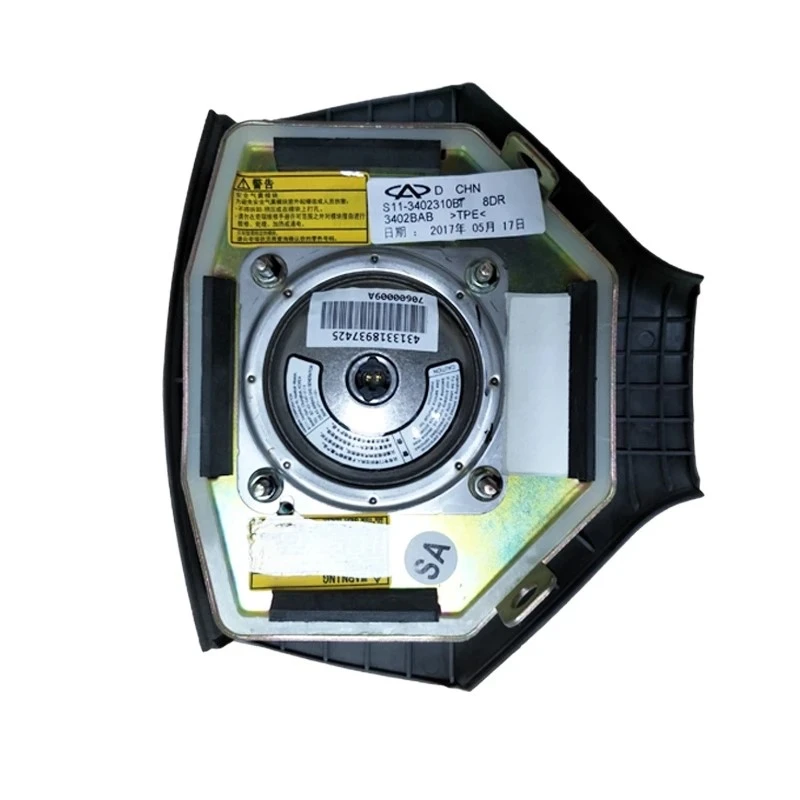
4. Electrical Connector and Wiring
Electrical connectors and their associated wiring link the airbag module to the relevant circuits within the vehicle's safety restraint system. Once the system control unit receives data from sensors and determines that deployment criteria have been met, it issues the appropriate trigger signal as per the system design.
Connectors must meet specific requirements for electrical performance, mechanical retention, and environmental durability. For automotive component suppliers, key considerations include connection reliability, terminal integrity, insulation properties, and assembly consistency.
Airbag circuits typically incorporate specialized ignition loops; therefore, they should not be tested using standard electrical diagnostic methods, nor should the connectors or wiring be modified in any way.
5. Cover and Deployment Structure
Some airbag modules feature a decorative cover or a purpose-designed deployment structure. These components protect the internal parts of the module while ensuring visual integration with the steering wheel, dashboard, or other interior surfaces.
Upon deployment, these structures must open or separate exactly as designed to allow the airbag to inflate properly. The material properties, seam design, and opening characteristics are rigorously validated to ensure they do not interfere with the airbag's deployment process.
6. Distinction Between Airbag Control Unit and Collision Sensors
The airbag control unit and collision sensors are distinct components of the vehicle's safety restraint system and are not necessarily housed within the airbag module itself.
- Airbag Control Unit (ACU): This unit processes signals from various sensors and, based on its control logic, determines whether to trigger the appropriate safety restraint devices. - Crash Sensor: Used to detect acceleration or other specified parameters related to a collision and to provide signals to the control system.
- Airbag Module: Typically consists of an airbag cushion, an inflator, mounting structures, and related connecting components; the exact composition depends on the specific product design.
While these components work together, their respective scopes of supply must be clearly defined during procurement, assembly, and quality management to avoid conflating the complete occupant restraint system with an individual airbag module.
FAQ: Frequently Asked Questions About Airbag Modules
Q1: Does an airbag module include a controller?
Not necessarily. A typical airbag module consists primarily of an airbag cushion, an inflator, and mounting structures. The controller is usually a separate component within the vehicle's occupant restraint system; the exact configuration depends on the product design and the defined scope of supply.
Q2: Can airbag modules be interchanged between different vehicle models?
No-similarity in appearance does not imply interchangeability. Modules for different vehicle models may vary in terms of inflation characteristics, mounting structures, connection interfaces, and control strategies. Selection must strictly follow the part numbers and compatibility requirements specified by the vehicle manufacturer.
Q3: What quality inspections are required for airbag modules? The specific items depend on the product type and customer specifications; they typically involve checks on materials and dimensions, assembly quality, and electrical connections, as well as production process traceability and the verification of specified performance and reliability.


